Ant Control in Columbus
Tiny ants on a Columbus kitchen counter are usually odorous house ants or pavement ants, and slow-acting bait placed on their trail does more than spraying. Big black ants inside, especially in spring, are carpenter ants, and they usually mean damp wood somewhere in the house.
Call (614) 699-5527Ask for an inspection
Licensed companies only: an Ohio Department of Agriculture pesticide business license. Check any license yourself
On this page
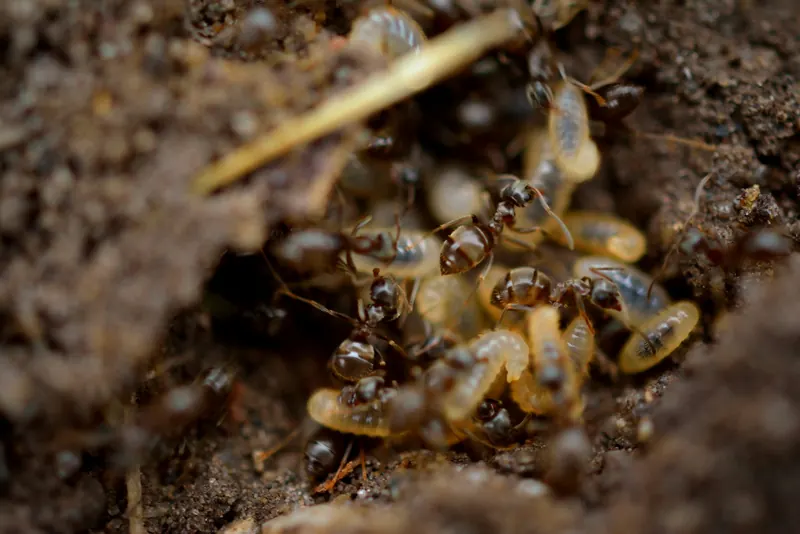
Start by figuring out which ant you have, because the small sugar and grease ants and the carpenter ant are different problems. One is a nuisance you can often handle with bait. The other is a sign of wet wood, and it is worth having someone find the nest.
If you can get a clear photo of a few ants next to a coin, send it before anyone treats.
The small ants: odorous house ants and pavement ants
Odorous house ant
Ohio State University Extension's fact sheet on ants in and around the home describes odorous house ant workers as about 1/10 inch long and brown to dark brown. Crush one and it smells like "rotten coconuts," which is the easiest way to tell. OSU says they "occasionally forage indoors for sweets and other foods."
Pavement ant
Pavement ant workers run 1/12 to 1/4 inch, light brown to blackish, with fine grooves on the head and thorax. OSU says they nest outdoors under stones and in pavement cracks or masonry, and that they may nest indoors near a heat source in winter. In a Linden or Whitehall ranch, the crack in the driveway by the back door is where I would look first. They feed on grease and meat as well as insects, so they turn up near pet food and the stove.
Baits vs barrier sprays
For the small ants, slow bait is the tool I would start with. OSU's fact sheet explains why: "Toxic fast-acting baits kill foraging workers quickly, but are less effective than those that are slow-acting." A slow bait gets carried back to the nest and fed to the colony, which is where the problem lives.
OSU's practical steps, which I agree with:
- Find the trail. Put a dab of jelly or a scrap of bacon near where you see ants and watch where they go.
- Bait along the trail or treat the crack they come out of. "Never treat entire walls, floors, countertops, cupboards, etc."
- Seal the cracks where ants enter, and clean up the food they are after.
- Skip bug bombs. OSU says the fumes do not reach the nest.
Do not spray over the bait. Many sprays repel ants, and a repelled ant stops feeding on the bait and carrying it home. OSU notes ants can avoid treated surfaces, and I think that is why so many DIY ant problems keep coming back.
Barrier sprays have a place outside. A licensed technician treating the foundation and the spots where ants come in, while baiting inside, is a reasonable plan for a house that gets ants every spring. OSU notes that for outdoor perimeter control you should prune plants touching the foundation and expect to reapply periodically. For a serious infestation, it recommends a licensed professional, since many of the products are restricted-use.
If ants come back every spring, ask for an inspection and a written price on an inside-and-outside plan.
Carpenter ants: the ones that mean wet wood
OSU's carpenter ant fact sheet (HYG-2063, 2017) says the black carpenter ant is the most common carpenter ant in Ohio. Workers are black with fine pale hairs on the abdomen, and range from about 1/4 inch for small workers to 1/2 inch for large ones. Winged swarmers usually come out from March to July, and the workers forage mostly at night.
The fact sheet makes the key point plainly: "Unlike termites, carpenter ants do not consume wood." They hollow it out to nest. The main nest, the parent colony, is in damp, decayed wood, often with moisture content above 15 percent, from a leak or from condensation. Satellite nests can sit in drier places such as wall voids and porch posts, even hollow doors.
That is why carpenter ants are common in older Columbus houses. 56% of homes in German Village's 43206 ZIP were built before 1940, and 59% of Clintonville's 43214 homes before 1960 (Census ACS data in our Columbus pest data). Old porch columns and window sills with failed paint, and sill plates sitting on a damp stone foundation, are the kind of wood the parent colony looks for.
Signs to look for
- Piles of coarse sawdust that OSU compares to "pencil sharpener shavings," often with bits of dead insects mixed in, below a sill or a crack in trim.
- Smooth, clean galleries inside the wood with no mud in them. Termite galleries have soil.
- Winged carpenter ants indoors during the March to July swarming season.
- A faint rustling sound in a wall, which OSU says an active colony can make.
Winged ants and winged termites are easy to confuse in April. OSU says ants have a pinched waist and elbowed antennae, while termites have a thick waist and straight, beaded antennae. If you are unsure, our termite swarm season guide shows the difference, and it is worth a photo.
Carpenter ant treatment
OSU is clear that the colony is only eliminated by killing the queen, so spraying the ants you see is not treatment. The steps it lays out:
- Find the parent nest and any satellite nests. OSU calls this the hardest and most important step.
- Treat the nest directly with dusts or aerosols injected into the galleries, or remove the infested wood.
- Use bait on foraging trails and at entry points, and do not combine it with sprays or dusts.
- Treat the foundation outside, about 2 feet up and 3 feet out, reapplying every four to six weeks in summer or after heavy rain.
Then fix the water. Clean the gutters and repair the roof or flashing leak, replace the rotted wood, and break any wood-to-soil contact. OSU also suggests trimming branches that touch the house, storing firewood off the ground, and removing dead stumps within about 50 feet of the house if practical. If the moisture stays, a new colony will move into the same wood.
A good carpenter ant visit should end with the technician showing you where the nest was, and naming the moisture source you need to fix. If they cannot find one, ask why.
For a written plan from a licensed local company, start with an inspection.
What ant treatment costs
This Old House (updated March 12, 2026) lists a national range of $100 to $500 for ant treatment. For carpenter ants, ask whether the quote includes finding the nest and a follow-up visit, and compare written prices. Our Columbus cost guide covers other pests, and our general pest control page covers ongoing plans that include ants.
We only refer companies that hold an Ohio Department of Agriculture pesticide business license and send licensed commercial applicators.
Questions people ask
What are the tiny ants in my kitchen in Ohio?
Most often odorous house ants, which smell like rotten coconut when crushed, or pavement ants, which nest under slabs and stones and leave small piles of sand. Both respond well to slow-acting bait on their trail.
Do ant baits work better than spray?
For colony ants, slow-acting baits usually work better because workers carry them back to the nest. Ohio State Extension advises against spraying whole walls or countertops; products belong in cracks or bait stations.
Do carpenter ants mean I have a moisture problem?
Usually. Ohio State Extension says the parent nest is in damp, decayed wood, often above 15 percent moisture from leaks or condensation. Find and fix the water source or the ants will return.
Do carpenter ants eat wood?
No. Ohio State Extension notes that carpenter ants do not consume wood; they excavate it to nest and push out coarse shavings.
How do I tell flying ants from termites?
Ants have a pinched waist and elbowed antennae. Termites have a thick waist and straight, beaded antennae. When in doubt, take a photo before anyone treats.
Sources
- OSU Extension HYG-2064, Ants In and Around the Home (Shetlar, Bloetscher, Andon, February 6, 2013)
- OSU Extension HYG-2063, Carpenter Ants (S. Jones, October 6, 2017)
- This Old House, Pest Control Cost (updated March 12, 2026)
- US Census Bureau, American Community Survey 2020 to 2024 5-year estimates, via our Columbus pest data