Termite Inspection and Treatment in Columbus
If you see winged termites in the basement or mud tubes on the foundation, get a licensed inspection before you agree to any treatment. Termite damage builds slowly, so you have time to get the diagnosis right and compare a second written price.
Call (614) 699-5527Ask for an inspection
Licensed companies only: an Ohio Department of Agriculture pesticide business license. Check any license yourself
On this page
The termite in Columbus houses is the eastern subterranean termite. It lives in the soil and comes up into wood that touches the ground or sits close to it. Treatment means a liquid termiticide in the soil around the house or a ring of bait stations, done by a company licensed in Ohio for termite work. Ask for a free inspection and a written price before any treatment.
The termite you are dealing with
Ohio State's Buckeye Yard and Garden onLine (BYGL) describes the eastern subterranean termite as the termite people find in Ohio homes, and says it swarms in spring and early summer here. A swarm inside an infested house can put out thousands of winged termites, and they collect at windows and lights. A swarm is the most common way people find out they have termites at all.
Old housing stock gives them plenty to work with. About 35% of homes in Columbus city ZIP codes were built before 1960, and in German Village 56% went up before 1940, per Census figures on our Columbus pest data page. Porches, sill plates, basement stair stringers and window frames near grade are where I would look first in those houses. Newer houses in Dublin or Hilliard are not immune. OSU points to foundation cracks and mulch piled against the house as ways in, and a new house can have both.
Signs worth calling about
- Winged termites indoors, or piles of shed wings on a windowsill or basement floor.
- Mud tubes on foundation walls or piers. OSU says the tubes are built from soil mixed with saliva and chewed wood.
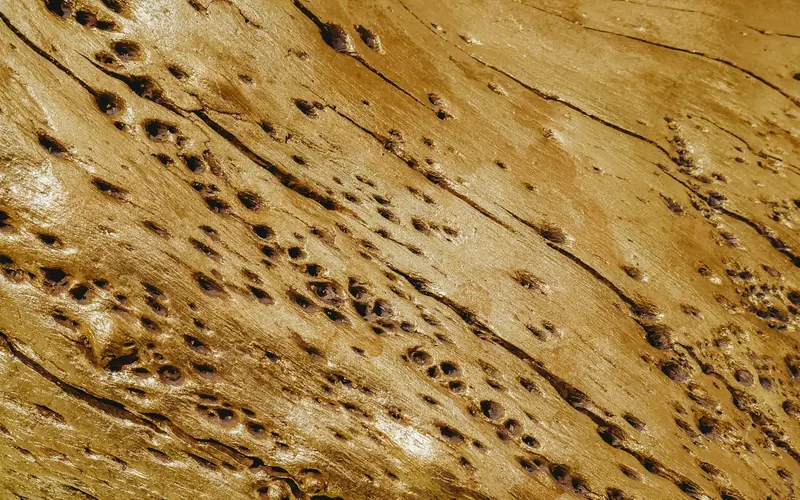
- Wood that sounds hollow or crumbles along the grain, with dirt packed in the galleries. OSU notes the surface can look intact while the wood behind it is eaten out, and paint can bubble or show lumps over the damage.
Flying ants get mistaken for termites every spring. OSU gives the quick test: termite swarmers have straight antennae, four wings of about the same size and a thick waist; ants have bent antennae, bigger front wings and a pinched waist. Our termite swarm season guide covers the timing and the look-alikes, and ant control covers carpenter ants, which also damage wood.
If you are not sure what you found, a clear photo usually settles it before anyone visits.
What the inspection should cover
A termite inspector walks the foundation inside and out and goes through the basement or crawlspace. Expect them to check the sill plate and joists, and any porch or deck where wood meets soil. OSU recommends a moisture meter because termite-infested wood usually reads damp. You should come away with a written report that says what was found and where. That includes live termites and old damage, and also conditions that invite them, like mulch piled against the siding.
Ohio treats this as licensed work. Applying termiticide for hire takes an Ohio commercial pesticide applicator license, and category 10b on that license covers termite control, per OSU Extension's licensing fact sheet. Our license guide shows how to look up the person who will treat your house.
Inspections for a home sale
A wood-destroying insect (WDI) inspection for a real estate deal is its own license category in Ohio. The Ohio Department of Agriculture says the company doing it needs a pesticide business license even if it will not treat anything, the inspector needs a commercial applicator license with category 12, and the findings have to be reported on the NPMA-33 Wood Destroying Insect Inspection form.
Whether your loan needs one depends on the loan:
- VA loans: VA's local requirements page (last updated July 11, 2025) lists Ohio among the states where wood-destroying insect information is required for the entire state. Expect a WDI report on any VA purchase in Columbus.
- FHA loans: HUD's archived guidance says FHA asks for an inspection when there is evidence of active infestation, when a state or local rule requires it, when it is customary in the area, or when the lender wants one. I could not confirm the current FHA handbook wording, so ask your lender early.
- Conventional loans: lenders may require one, and many buyers order one anyway. Ask your lender and your agent.
Liquid treatment vs bait stations
OSU's BYGL lays out the two main options.
Liquid soil termiticides go into the soil around the foundation, so termites tunneling through the treated zone are exposed. Most products used now are non-repellent: termites do not avoid them, and the slow action lets the toxin spread through the colony. OSU notes two weak points. Gaps can open as soil shifts, and use is restricted near water and other sensitive areas, which matters for a house with a well or a creek out back.
Bait stations go into the ground around the perimeter, about every 10 feet per OSU, and hold cellulose laced with a slow-acting insecticide that stops termites from molting. They work on termites that find them, so they can take longer, and OSU says some installs start with untreated bait to draw termites in. Ask how often someone checks the stations and what that monitoring costs each year.
I would not rely on DIY products for an active infestation. OSU says cultural steps alone cannot eliminate one and should be paired with professional treatment. Those steps still help after treatment:
- Pull wood away from the soil, including firewood stacked against the house.
- Keep mulch thin and at least 6 inches below the top of the foundation so the inspector can see it.
- Clean the gutters and extend downspouts away from the walls.
- Slope soil so water runs away from the foundation.
- Seal cracks in the foundation where you can reach them.
Published national prices for each method are in our Columbus pest control cost guide.
Read the termite contract before you sign
Many companies sell termite treatment with an annual contract, often called a bond or protection plan. This Old House (June 2026) says one adds $500 to $2,000 to the total cost. The contract is where the real differences between two quotes hide, and I would read it line by line before comparing prices. Ask for these answers in writing:
- Does the contract only promise to re-treat if termites come back, or does it also pay to repair new damage? If repairs are included, what is the dollar limit, and what damage is excluded?
- Ask whether it covers damage that existed before the contract started, and get the old damage written down on day one.
- What does the yearly renewal cost after year one, and can the company raise it?
- Does the contract transfer to a buyer if you sell, and is there a fee?
- For baits, how many monitoring visits a year are included?
- What can cancel it, such as a new addition, a moved downspout or mulch piled against the foundation?
Two quotes for the same house can differ by thousands of dollars because one covers repairs and the other covers re-treatment only. Neither is wrong; know which one you are buying. The quote checklist covers red flags in the sales pitch itself.
We only refer companies that hold an Ohio Department of Agriculture pesticide business license and send licensed commercial applicators. If you want a termite inspection with a written report and price, start here.
Questions people ask
Are termites common in Columbus?
Ohio State Extension says the eastern subterranean termite is found in Ohio homes and swarms in spring and early summer. Older houses with wood near the soil are the usual targets.
How do I know if I have termites or flying ants?
Termite swarmers have straight antennae, four wings of about the same size and a thick waist. Flying ants have bent antennae, larger front wings and a pinched waist, per Ohio State's BYGL.
Does a VA loan in Ohio need a termite inspection?
VA's local requirements page lists Ohio among the states where wood-destroying insect information is required for the entire state. Your lender will order or ask for the report.
Who can do a termite inspection for a home sale in Ohio?
The Ohio Department of Agriculture says the inspector needs a commercial applicator license with category 12, the company needs a pesticide business license, and results go on the NPMA-33 form.
Is liquid treatment or a bait system better for termites?
Liquid soil treatment puts a treated zone around the foundation, while baits are spaced about every 10 feet and rely on termites finding them. Which one fits depends on the house, so ask for both in writing and compare the price over several years, including monitoring.
Can I treat termites myself?
Ohio State Extension says cultural steps alone cannot eliminate an active infestation and should be combined with professional treatment. Removing wood-to-soil contact and keeping mulch low still help.
Sources
- Ohio State University BYGL, Eastern Subterranean Termite (May 13, 2024)
- OSU Extension ANR-0140, Ohio Commercial Pesticide Applicator Requirements (September 27, 2023)
- Ohio Department of Agriculture, Pesticide Businesses (WDI inspection business), accessed October 28, 2026
- U.S. Department of Veterans Affairs, Local Requirements (last updated July 11, 2025)
- HUD Archives, HOC Reference Guide: Pest Control (archived November 2, 2012)
- This Old House, How Much Does Termite Treatment Cost? (updated June 17, 2026)
- Ohio Revised Code 921.09, Pesticide business license (effective September 30, 2025)